
How to Choose the Right Motocross Jersey Size
Table of Contents
- Why Getting Your Motocross Jersey Size Right Matters
- Gather Your Measurements: The Foundation for Proper Fit
- Understanding Adult Size Ranges and Sport Fit
- Using a Size Chart to Compare Body and Garment Measurements
- Motocross Gear Sizing Guide: Brand and Model Differences
- How to Measure for Motocross Armor and Protective Equipment
- Best Practices for Motocross Apparel Maintenance
- Youth Sizing and Growth Room for Young Riders
- Frequently Asked Questions
Last Updated: October 5, 2026
Why Getting Your Motocross Jersey Size Right Matters
A poorly fitting motocross jersey can ruin your riding experience. Too tight and you can't move freely. Too loose and it flaps around, distracting you mid-ride. Getting the right fit isn't just about comfort, it affects your control, safety, and how long your gear actually lasts.
Motocross jersey sizing varies wildly between brands, a medium in one might be small or large in another. This guide walks you through the exact steps to find your perfect fit.
Gather Your Measurements: The Foundation for Proper Fit
Before checking any size chart, take accurate body measurements over what you'll actually wear under the jersey. A measurement error of even half an inch can push you into the wrong size.
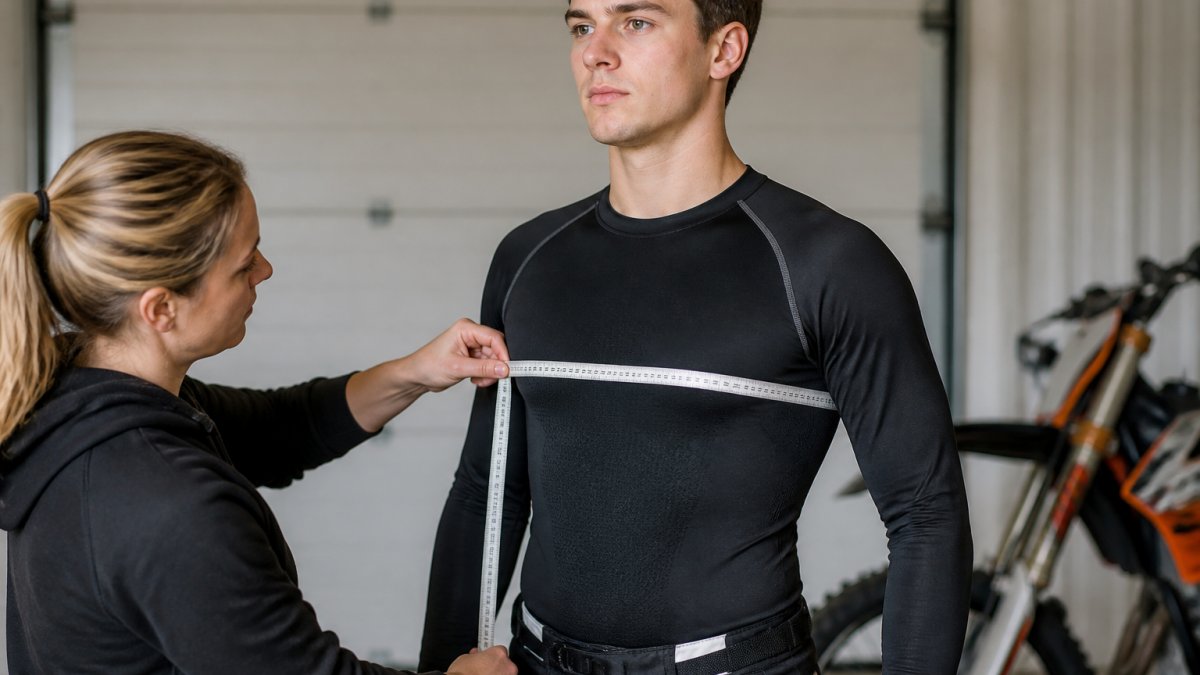
Decide: Base Layer Only, or Base Layer Plus Armor?
Your first decision determines everything that follows. Will you wear the jersey over a base layer alone, or over a base layer plus protective gear (chest protector, back protector, shoulder pads)?
If you wear armor regularly, measure with armor on, a jersey sized to base-layer-only will be too tight and shift protection out of place. If you wear armor occasionally, size for armor and accept a looser fit without it. If you never wear armor, measure over your base layer alone. Write down which scenario applies before measuring.
Chest and Armpit-to-Armpit Measurement
Use a soft cloth measuring tape (metal can kink and give false readings). Have someone help you; self-measurement often introduces error.
Chest measurement:
- Wear your base layer (and armor, if applicable) in a relaxed, neutral posture.
- Measure horizontally around the fullest part of your chest, keeping the tape snug but not compressing fabric. You should slide one finger under it.
- Record to the nearest half-inch, rounding up if between marks.
- Take three measurements and average them.
Armpit-to-armpit measurement:
- Measure from the center of one armpit straight across to the center of the other, keeping the tape level.
- This determines whether a jersey will bind across the shoulders during riding. Many riders overlook this and end up with restricted arm movement.
- Record to the nearest half-inch.
Height and Weight as Fit References
Height and weight are secondary references. Taller riders need longer jerseys to prevent riding up; heavier riders might need a size up. If your chest and armpit measurements fall between two sizes, use height and weight to decide. Always prioritize chest and armpit measurements over height and weight alone.
Common Measurement Mistakes to Avoid
Common mistakes: Measuring over street clothes instead of your actual base layer; tape too loose or too tight; slouching or puffing up; rounding down instead of up; forgetting to write measurements down. Always measure over what you'll wear, keep tape snug but not compressing, stand naturally, round up, and record everything.
Understanding Adult Size Ranges and Sport Fit
Most motocross jersey brands use standard size labels, but "sport fit" is cut tighter with shorter sleeves and body length. You'll likely wear a size smaller in sport fit than in everyday apparel. Check the brand's size description, some run generous, others run small.
Using a Size Chart to Compare Body and Garment Measurements
A size chart shows body size ranges and garment measurements. Match your body measurements to the garment measurements, not the body size label.
Find your chest and armpit-to-armpit measurements on the garment column. If both fall in the same size, that's your size. If they differ, armpit measurement usually takes priority. Longer arms or torso might push you up a size even if chest measurement is smaller.
| Measurement Type | What It Tells You | Why It Matters |
|---|---|---|
| Chest (garment) | Overall width | Determines if jersey hugs or hangs |
| Armpit-to-armpit (garment) | Shoulder and arm room | Affects mobility and comfort during riding |
| Sleeve length (garment) | Arm coverage | Prevents riding up and exposes |
| Body length (garment) | Torso coverage | Keeps jersey from riding up during riding position |
Motocross Gear Sizing Guide: Brand and Model Differences
Not all motocross jersey brands size the same way. A medium in Brand A might be 19 inches chest width, while Brand B's medium is 20.5 inches. Always check the specific brand's size chart, switching brands might mean switching sizes. Some brands also make different fits within their line, so verify the specific model's measurements. Keep a note of your size in each brand you wear.
How to Measure for Motocross Armor and Protective Equipment
Armor adds bulk that changes jersey fit dramatically. Account for that thickness when choosing your size. Undersizing over armor is a safety risk, protection can shift out of position.
Measuring with Armor: The Right Way
Measure your chest and armpit-to-armpit while wearing your base layer and full protective setup (chest protector, back protector, shoulder pads, elbow and forearm guards). Don't estimate or measure armor separately, the way it sits on your body, compressed under the tape, is what matters.
How Much to Size Up: A Practical Guide
Light armor adds 0.5-1 inch (usually stay same size or go up half-size). Medium armor adds 1-1.5 inches (go up one full size). Heavy armor adds 1.5-2 inches (go up one to two sizes). The only reliable method is to measure with your actual armor and compare to the size chart.
The Armor-Jersey Fit Conflict
Armor and jerseys are designed separately, and they don't always play well together. A jersey cut for a tight, race-fit silhouette might bind over bulky chest protection even if the chest measurement is correct. A jersey cut for a relaxed fit might be too loose in the shoulders even with armor.
If your jersey binds across the chest over armor:
- The chest protector is too bulky for that jersey's cut, or you sized correctly but the jersey's design is narrow in the chest.
- Solution: Go up another half-size, or switch to a brand known for a more relaxed fit.
- Do not try to compress the armor or wear it under the jersey in a way that shifts it, this defeats the purpose of protection.
If your jersey is loose in the shoulders but fits the chest:
- The armor's shoulder pads are not filling the jersey's shoulder width, or the jersey is cut wide in the shoulders.
- Solution: This is acceptable. A loose shoulder fit is safer than a tight one and won't affect control. If it bothers you, try a different brand with a narrower shoulder cut.
If the jersey rides up in the back over a back protector:
- The back protector is pushing the jersey up, or the jersey's body length is too short for your torso.
- Solution: Go up a size (which increases body length), or size up in body length only if the brand offers that option.
Armor Brand Sizing Notes
Some armor brands publish recommended jersey sizing. Check the armor's documentation or the manufacturer's website. For example, a bulky chest protector from one brand might require a size up, while a slim design from another brand might not.
If you're buying armor and a jersey together, check both size charts and size the jersey for the armor's bulk, not the other way around.
Switching Between Armor Setups
If you wear light armor for practice and heavy armor for competition, you have two choices:
Option 1: Size for heavy armor. The jersey will be loose over light armor, but loose is safe and acceptable. You'll have one jersey that works for both setups.
Option 2: Buy two jerseys. One sized for light armor (tighter fit, more control), one for heavy armor (roomier fit, more protection clearance). This is more expensive but gives you the best fit in both scenarios.
Most riders choose option 1 and size for their heavier setup.
Best Practices for Motocross Apparel Maintenance
Once you've found the perfect fit, maintain it properly so the jersey keeps its shape. Proper care extends the life of your gear and keeps it fitting right.
Wash your jersey in cold water with similar colors. Hot water can shrink fabric, especially polyfabric blends common in motocross gear. Turn the jersey inside out before washing to protect the graphics and reduce fading.
Use mild detergent. Heavy detergents can break down the moisture-wicking properties that keep sweat off your skin. Air dry whenever possible. High heat in the dryer shrinks fabric and damages elastic.
Check the care tag for specific instructions. Some jerseys have special coatings that require gentle handling. Ignoring the care tag is the fastest way to ruin sizing and fit.
Store jerseys folded or on hangers in a cool, dry place. Don't leave them bunched up in a gear bag for weeks. Moisture and heat cause mildew and fabric breakdown.
Youth Sizing and Growth Room for Young Riders
Young riders grow fast. Buying a jersey that fits perfectly today might be too small next season. This is especially true for kids aged 3 to 12.
Youth size ranges start at very small for toddlers and go up through teen sizes. Check the height and weight ranges carefully. A 3-year-old and a 7-year-old need completely different sizes, even though both are "kids."
Many parents buy youth jerseys one size up to allow for growth. This works if the fit is still safe and functional. A jersey that's too loose around the shoulders or arms affects control and safety.
Consider how long your child will ride in that jersey. If they're growing fast, buying a size up makes sense. If they're in a stable size range, fit them properly now and replace next season.
Some brands offer youth sizes in both regular and sport fit. Sport fit youth jerseys are cut smaller and tighter, matching the riding position.
Finding the right motocross jersey size takes a few minutes of measurement and chart comparison, but it saves you from returns, poor fit, and wasted money.
Frequently Asked Questions
How do I measure for a motocross jersey?
Use a soft measuring tape and measure your chest at the fullest point, keeping the tape snug but not tight. For armpit-to-armpit measurement, lay a jersey that fits you well on a flat surface and measure straight across from one armpit seam to the other. Measure your sleeve length from the center back of your neck, across your shoulder, down to your wrist. Record all three measurements and compare them against the size chart before ordering.
Should a motocross jersey be loose or tight?
A motocross jersey should fit snugly but allow full range of motion for the riding position. Sport fit jerseys are designed to sit closer to your body than casual t-shirts, reducing fabric flap during riding. You should be able to move your arms freely in a forward, gripping position without the jersey pulling up or restricting your shoulders. If you plan to wear body armor underneath, size up to accommodate the protective gear without compression.
Are motocross jersey sizes the same as standard t-shirt sizes?
No. Motocross jerseys typically run smaller and fit differently than standard t-shirts. They're designed with a sport fit for the riding position, meaning shorter sleeves and a narrower cut through the shoulders. Always refer to the specific size chart for the jersey brand you're buying rather than assuming your usual t-shirt size will work. Different brands also vary in sizing, so checking measurements before purchase is essential.
Do motocross jerseys shrink after washing?
Many motocross jerseys can shrink if washed in hot water or dried on high heat. To minimize shrinkage, wash in cold water and air dry whenever possible. Check the care label for your specific jersey's fabric content and follow the manufacturer's instructions. Polyfabric and moisture-wicking materials are common in motocross gear and may shrink slightly, so sizing with a small amount of room is a smart approach.