
Motocross Clothing for Young Riders: 2026 Parent's Guide
Table of Contents
- Why Motocross Clothing for Young Riders Is Different From Adult Gear
- Safety Standards and Protective Equipment That Actually Matter
- How to Size Kids Dirt Bike Gear Without Guessing
- Is Youth Motocross Protective Gear Worth the Investment?
- Jerseys, Pants, and Gear Combos: What Young Riders Need
- Motocross Lifestyle Apparel for Kids: Off the Bike, On the Go
- Durability, Comfort, and Gear Break-In Tips for Parents
- Frequently Asked Questions
Last Updated: September 17, 2026
Why Motocross Clothing for Young Riders Is Different From Adult Gear
Motocross clothing for young riders is not simply scaled-down adult gear.
The American Motorcyclist Association's youth rider resources notes that proper fitment is a leading factor in youth riding safety. That's not a marketing line. It's the difference between gear that protects and gear that just looks the part.
Safety Standards and Protective Equipment That Actually Matter
Youth motocross protective equipment should meet recognized safety certifications, and parents should verify those certifications before buying. In the United States, helmets must carry Department of Transportation (DOT) certification at minimum, and chest protectors and roost deflectors are tested against impact resistance standards. But the label on the box is only half the story, the other half is understanding what the certification actually covers.
The Certification Labels Parents Should Learn to Read
Helmets sold in the United States must meet FMVSS 218, the federal standard enforced by the National Highway Traffic Safety Administration. Many youth helmets also carry a Snell Memorial Foundation rating, which uses a different impact-test protocol and is widely respected in motorsport circles. A helmet that carries both DOT and Snell certification has passed two independent test regimes, which is a meaningful signal for parents.
- CE Level 1, the baseline. Transmits no more than 18 kN of force on impact. Suitable for casual trail riding and low-speed falls.
- CE Level 2, roughly twice the impact absorption of Level 1. The standard choice for riders who race or ride at higher speeds.
- Back protectors are graded separately under EN 1621-2, with Level 1 and Level 2 following the same force-transmission logic.
What to Look for in Chest Protectors and Knee Guards
Chest protectors for young riders need three things: a snug fit that doesn't shift, hard shell panels over the sternum and ribs, and ventilation channels so kids don't overheat. Knee guards should offer impact absorption at the kneecap plus side coverage for the joint.
Look for these features:
- Hard-shell chest plate with foam backing for impact absorption
- Adjustable shoulder straps that stay put during movement
- Knee guards with hinged or articulated construction
- Neck brace compatibility if your child rides at higher speeds
- Reinforced stitching at stress points
- A visible CE rating on the armor insert, not just the outer shell
Matching Protection to the Type of Riding
Not every young rider needs the same armor. A five-year-old on a 50cc trail bike and a twelve-year-old racing a 65cc class have very different impact profiles.
- Trail and backyard riding, DOT helmet, CE Level 1 chest protector, knee guards, gloves, and boots. A neck brace is optional at low speeds.
- Track practice and local racing, DOT/Snell helmet, CE Level 2 chest protector, hinged knee guards, neck brace, and reinforced boots.
- Competitive racing, the above plus a full neck brace, CE Level 2 back protector, and elbow guards. At race speeds, the difference between Level 1 and Level 2 armor is the difference between a bruise and a fracture.
How to Size Kids Dirt Bike Gear Without Guessing
Sizing kids' dirt bike gear starts with two measurements: chest circumference and inseam. Everything else follows from those two numbers. Take them in the morning, standing straight, wearing the base layer your child will actually ride in.
Here's a simple fitment guide parents can use:
| Gear Type | Key Measurement | Fit Check |
|---|---|---|
| Jersey | Chest circumference | Shoulder seams sit at shoulder edge, no gap at wrist |
| Pants | Waist and inseam | Knee pad sits over kneecap when standing |
| Chest protector | Chest and torso length | Bottom edge sits above belly button |
| Knee guards | Knee circumference | No rotation when leg bends 90 degrees |
| Boots | Foot length plus 0.5 inch | Toe touches front, heel locked |
Growth-Adjustable Gear That Stretches Your Dollar
Here's the problem no sizing chart solves: a child can grow two inches in a single summer. Gear that fit perfectly in April can gap at the wrists by August. Most guides tell parents to buy for today's fit and move on, but that advice ignores the reality that youth motocross gear is expensive and kids outgrow it fast.
- Adjustable waist tabs, pants with hook-and-loop or buckle tabs at the waist can expand two to three inches without changing the leg length. This handles the waist growth that happens before a height spurt.
- Extendable knee panels, some youth pants have a zippered or stitched panel at the knee that can be let out as the rider's inseam grows. This is the single most useful feature for riders in a growth phase.
- Removable armor inserts, chest protectors and knee guards with removable CE-rated inserts let you keep the shell and swap the padding as the child's body shape changes.
- Stretch panels at shoulders and knees, jerseys with four-way stretch fabric at the shoulders accommodate a wider chest without going up a size.
When to Size Up and When Not To
The old advice to "buy one size up so they can grow into it" is wrong for protective gear. Loose knee guards slide out of position during a crash. Baggy jerseys snag on handlebars. A chest protector that rides up exposes the ribs.
Is Youth Motocross Protective Gear Worth the Investment?
Youth motocross protective gear is worth the investment when it fits correctly and meets safety standards. The question isn't whether to buy protection; it's how to spend your budget wisely across the gear your child actually needs.
Used vs. New Gear Economics
Used gear can save money on items that don't degrade with wear, like chest protectors with hard shells and knee guards with intact padding. Skip used helmets entirely. Helmet foam compresses on impact and doesn't recover, so a used helmet may offer no real protection.
New gear makes sense for:
- Helmets (always buy new)
- Jerseys and pants, which wear at seams and stretch out
- Boots, which mold to the previous owner's foot
Used gear works for:
- Chest protectors with no cracks or deep scratches
- Knee guards with intact foam and no bent hinges
- Goggles with clean, unscratched lenses
Jerseys, Pants, and Gear Combos: What Young Riders Need
Jersey and pant sets designed for youth riders use moisture-wicking fabric, stretch panels at the knees and shoulders, and reinforced stitching at contact points. A complete set typically costs less than buying pieces separately, and the fit is designed to work together.
Look for these construction details:
- Moisture-wicking fabric that pulls sweat away from skin
- Ventilation panels under the arms and behind the knees
- Abrasion resistance at the elbows and seat
- Ergonomic fit that allows full range of motion
- Lightweight materials that don't restrict movement
Motocross Lifestyle Apparel for Kids: Off the Bike, On the Go
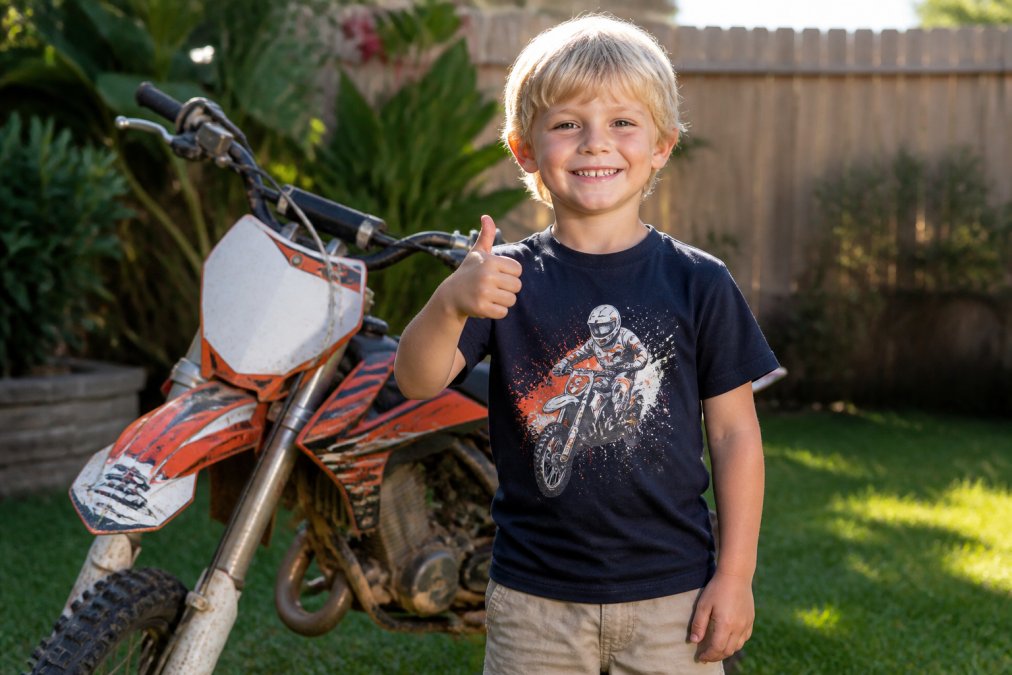
Motocross lifestyle apparel for kids extends the riding passion beyond the track. Graphic tees and hoodies let young riders show their love for the sport at school, family events, and around the house.
Durability, Comfort, and Gear Break-In Tips for Parents
To make gear last longer:
- Wash jerseys and pants inside out in cold water
- Air dry instead of using a dryer, which breaks down stretch panels
- Inspect knee guards and chest protectors after every crash
- Store gear clean and dry, away from direct sunlight
- Check stitching at stress points monthly
Gear maintenance isn't glamorous, but it's the difference between gear that lasts one season and gear that lasts three.
Frequently Asked Questions
What is a good motocross outfit for kids just starting out?
For beginners, start with a jersey and pant set made from moisture-wicking fabric with reinforced stitching at the knees. Add a chest protector, knee guards, and gloves sized to their measurements. Youth motocross clothing should prioritize full-body protection and breathability over style. Look for gear with stretch panels for movement and ventilation to keep them cool on the track.
How should youth motocross gear fit for maximum safety?
Youth motocross gear should fit snug but not restrictive, allowing full range of motion while staying in place during impact. Jerseys should cover the lower back when arms are extended. Pants need to stay up without bunching at the knees. Always check that chest protectors and knee guards sit correctly over the body, not sliding around. A proper fitment guide from the manufacturer helps, but measuring your child's chest, waist, and inseam gives the most accurate result.
Is youth motocross protective gear worth the investment?
Yes, youth motocross protective gear is worth the investment because children are still developing coordination and are more prone to falls. Quality gear with impact resistance and abrasion resistance protects against common injuries. While the upfront cost may seem high, replacing cheap gear that falls apart after a few washes costs more over time. Look for gear with safety certifications and durable materials like reinforced stitching and impact absorption padding.
Where can I find motocross lifestyle apparel for kids?
Moto Dad Racing offers motocross lifestyle apparel for kids, including the Eat Sleep Ride Youth T-Shirt ($19.99) made from 100% ring-spun cotton with a tear-away label for comfort. Their collection includes tees designed for young riders who want to show their passion off the bike. These pieces work for school, family outings, or just hanging around the house.