
Best Motocross Gear for Hot Weather Riding
Table of Contents
- Why Hot Weather Motocross Gear Requires Different Specs
- Breathable Mesh Fabrics and Ventilation: Core Features That Matter
- Moisture-Wicking Base Layers for Riders: What Actually Works
- Motocross Hydration Systems and Heat-Stroke Prevention
- Vented Motocross Pants and Lightweight Helmet Design
- Impact Protection vs. Weight: The Trade-Off in Summer Gear
- Post-Ride Gear Care for Sweat and Salt Buildup
- Moto Dad Racing Family Apparel: Comfort for the Whole Crew
- Frequently Asked Questions
Last Updated: September 30, 2026
Why Hot Weather Motocross Gear Requires Different Specs
When temperatures climb above 85°F, the best motocross gear for hot weather riding demands a completely different approach than cooler-season equipment. Hot-weather gear isn't just lighter, it's engineered around three core principles: airflow management, moisture transport, and impact protection that doesn't trap heat.
Riding in extreme heat without proper ventilation leads to thermal fatigue, reduced grip strength, and slower reaction times. The best motocross gear for hot weather riding solves this by using breathable mesh fabrics, moisture-wicking base layers, and articulated ventilation channels that work together to keep you cool while maintaining protection.
The key difference between summer-specific motocross gear and all-season equipment comes down to material composition, panel placement, and base layer strategy.
Breathable Mesh Fabrics and Ventilation: Core Features That Matter
The best motocross gear for hot weather riding uses strategic mesh placement combined with internal airflow channels that create a cooling effect as you ride. When positioned over high-heat zones (chest, back, shoulders), mesh allows air to flow directly across your skin while the outer shell protects against abrasion.
Look for gear with perforated leather panels that combine protection with breathability.
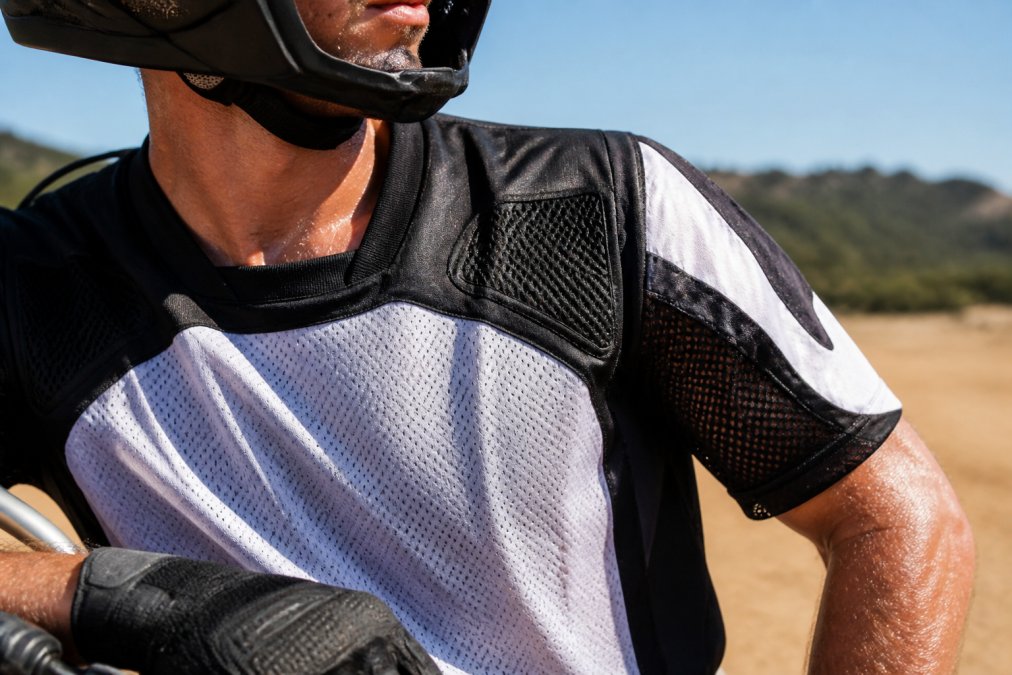
The best designs use a hierarchy: maximum mesh over the core (chest, back), partial mesh on the sides, and reinforced panels on impact zones. Ventilation channels running from shoulders to waist create a chimney effect that pulls hot air up and out of the jacket as you accelerate.
Moisture-Wicking Base Layers for Riders: What Actually Works
Moisture-wicking base layers are non-negotiable for hot-weather motocross. They sit directly against your skin and pull sweat away, allowing it to evaporate through outer layers. Without them, sweat pools against your skin, reducing cooling ability and causing chafing.
The best base layers use poly-fabric blends that transport moisture outward. Cotton absorbs sweat and holds it against your skin; synthetic blends dry quickly and maintain moisture-transport properties even when saturated.
Tight base layers work better than loose ones because they maintain consistent contact with your skin, maximizing moisture transfer. Look for flat-seam construction to eliminate chafing points. The base layer does the actual thermal regulation work, not the outer jacket.
Motocross Hydration Systems and Heat-Stroke Prevention
Hydration systems built into gear are safety equipment in extreme heat. A hydration bladder with a tube running to your helmet allows you to drink without removing your hands from the grips, preventing dehydration during intense riding.
Drink 16-20 ounces of water 2-3 hours before riding, then 8 ounces 20 minutes before starting. During the ride, aim for 4-8 ounces every 15-20 minutes.
Watch for heat-exhaustion warning signs: dizziness, nausea, loss of grip strength, or sudden coldness despite the heat. The best motocross gear for hot weather riding includes hydration integration because it removes friction from the hydration process.
Vented Motocross Pants and Lightweight Helmet Design
Vented motocross pants are equally important as jackets. The best summer pants use mesh side panels running the full length of the leg, combined with perforated leather in the seat and knee areas, creating airflow while maintaining impact protection.
Look for helmets with large, strategically-positioned vents that create a low-pressure zone, actively pulling air through the interior. Some designs include removable padding that reduces heat retention without compromising fit.
Impact Protection vs. Weight: The Trade-Off in Summer Gear
CE-rated armor adds weight, which directly increases core body temperature in extreme heat. A full suit of shoulder, elbow, knee, and back protection can add 2-3 pounds.
The best motocross gear for hot weather riding solves this through material science. Modern summer-specific armor uses three alternative approaches:
Expanded Polyurethane (EPU) vs. Dense Foam:
Gel-Based Compounds: TPU gel inserts absorb energy through shear deformation, allowing thinner panels.
Segmented vs. Full Coverage: Full-body armor totals 3-4 pounds.
Don't skip back protection under any circumstance. A lightweight back protector (8-12 ounces) adds minimal weight but protects your spine, the one area where impact injuries are catastrophic and non-recoverable. Spinal injuries don't heal, they disable.
The gear-weight trade-off is real, but it's not binary.
Post-Ride Gear Care for Sweat and Salt Buildup
Sweat and salt buildup degrade the engineered properties that make summer gear work. Understanding this damage extends gear life by 2-3 seasons.
When sweat dries on mesh fabric, salt crystals remain embedded in the weave, blocking airflow, degrading moisture-wicking properties, and breaking down synthetic fibers. Salt crystals are hygroscopic, absorbing atmospheric moisture and creating a permanent damp microclimate that breeds bacteria and mildew.
Immediate Post-Ride Protocol (Within 30 Minutes):
Rinse your gear with cool water while sweat is still wet. This is critical, wet salt crystals are still soluble and wash away easily. Once they dry, they bond to the fabric and require aggressive scrubbing to remove. Use a garden hose or sink spray, working from the outside in. Pay special attention to mesh panels, seams, and the interior lining where salt accumulates most heavily. Spend 2-3 minutes on high-sweat zones: chest, back, underarms, and the inside of the helmet.
Flip jackets and pants inside-out and rinse the lining directly. A 2-minute interior rinse prevents permanent odor and preserves moisture-wicking properties.
Weekly Deep Clean (Every 3-4 Rides):
Use cool water and mild soap (pH-neutral, like Woolite or sports-specific gear wash). Never use hot water, heat sets protein-based sweat stains permanently and can damage synthetic fabrics. Fill a sink or bucket with cool water, add 1-2 tablespoons of soap, and submerge mesh panels and seams for 10 minutes. Use a soft brush (not a scrub brush) to gently work the lather into the weave, focusing on seams where salt crystals accumulate in dense clusters.
For stubborn salt buildup, use a 50/50 white vinegar and water solution. Vinegar is acidic and dissolves salt crystals without damaging fabric. Soak affected areas for 15 minutes, then gently brush and rinse thoroughly with cool water. The vinegar smell dissipates completely once the gear dries.
Never use a washing machine, agitation breaks down mesh panels and separates armor from backing. Hand-washing extends gear life.
Drying and Storage:
Air dry completely before storing, this is non-negotiable. Moisture trapped in gear creates mildew, which destroys breathability and creates permanent odor that no amount of washing removes. Hang gear in a well-ventilated area, ideally in sunlight (UV helps kill bacteria). Don't use a dryer or direct heat, synthetic fabrics can melt or warp. Drying typically takes 24-48 hours depending on humidity. Check that the interior lining is completely dry before storing; moisture hidden in seams or padding can cause mildew in as little as 48 hours.
Store gear in a breathable bag or open shelf, never in sealed plastic. A mesh storage bag allows air circulation while protecting from dust.
Restoring Moisture-Wicking Properties:
After 8-10 deep cleans, even well-maintained gear loses some moisture-wicking efficiency because salt residue and detergent buildup coat the synthetic fibers. Restore this by soaking the gear in cool water with 1 tablespoon of white vinegar per gallon for 20 minutes, then rinsing thoroughly and air-drying. The vinegar removes mineral and detergent buildup without damaging fabric. This single step can help restore moisture-wicking performance.
Check mesh panels monthly for small tears.
Helmet Interior Care:
Remove the interior padding if possible and rinse separately. If glued in, use a damp cloth to wipe the interior. Air dry completely with the visor open. Never store in a sealed bag, trapped moisture degrades the EPS foam liner. Use a breathable helmet bag or open shelf storage.
Moto Dad Racing Family Apparel: Comfort for the Whole Crew
Matching gear as a family brings a different challenge: sizing across ages while maintaining consistent quality and fit. Moto Dad Racing offers motocross-themed apparel designed for the entire family, from fathers to young children, so you can represent your shared passion without sacrificing comfort.
The Father son Tee at $28.99 uses Sport-Tek's PosiCharge technology with 100% polyester interlock construction and moisture-wicking properties. This means the apparel handles sweat management for active families, whether you're wearing it at the track or around town. The removable tag design adds comfort for extended wear, and sizing runs from XS to 4XL.

For riders seeking a softer feel, the Ride 2 at $28.99 uses a tri-blend fabric (50% polyester, 25% combed ringspun cotton, 25% rayon) that delivers comfort without sacrificing durability. The fabric is pre-laundered to prevent shrinkage, and the satin label eliminates neck irritation during long days at the track.

| Product | Price | Material | Best For | Key Feature |
|---|---|---|---|---|
| Father son Tee | $28.99 | 100% polyester with PosiCharge | Active families | Moisture-wicking, removable tag |
| Ride 2 | $28.99 | Tri-blend (poly/cotton/rayon) | Comfort seekers | Pre-laundered, satin label |
| Man myth racer | $28.99 | Tri-blend (poly/cotton/rayon) | Matched family outfits | Shoulder taping, flat seams |
Frequently Asked Questions
Should I ride my motorcycle in 100 degree weather?
Yes, but only with proper motocross gear for hot weather designed to manage heat and protect you from dehydration. Wear moisture-wicking base layers, vented pants with mesh panels, and ensure you have a hydration system accessible during breaks. Monitor yourself for heat exhaustion symptoms like dizziness or excessive fatigue, and take frequent water breaks. The right gear keeps you safe and cool.
What features should I look for in summer motocross gear?
Prioritize breathable mesh fabrics with ventilation channels, moisture-wicking technology to pull sweat away from skin, lightweight construction to reduce fatigue, and CE-rated armor that doesn't trap heat. Look for perforated leather panels, articulated joints that allow airflow, and removable padding where possible. Vented gloves and a lightweight helmet with airflow design are equally important for thermal regulation.
How does moisture-wicking technology work in racing apparel?
Moisture-wicking fabrics like polyester and tri-blend materials actively transport sweat away from your skin to the outer surface, where it evaporates faster. This keeps you drier and cooler during hot weather riding. Unlike cotton, which absorbs sweat and holds it against your skin, moisture-wicking base layers allow air to circulate and prevent thermal buildup that leads to riding fatigue and heat exhaustion.
What is the best way to stay hydrated while riding in hot weather?
Use a hydration bladder system integrated into a lightweight pack or vest designed for motocross, allowing you to drink hands-free during breaks. Drink water consistently before, during, and after your ride rather than waiting until you're thirsty. Avoid caffeine and alcohol beforehand, as they increase dehydration. Plan your route with water stops, and consider electrolyte drinks to replace salts lost through sweat.