
Signs Your Child Has Outgrown Their Motocross Gear
Table of Contents
- Why Outgrown Motocross Gear Is a Safety Problem, Not Just a Comfort One
- 7 Signs Your Child Has Outgrown Their Motocross Gear
- Youth Motocross Gear Sizing Guide: How to Measure at Home
- How to Fit a Child's Motocross Helmet (and Know When It's Too Small)
- Is Youth Motocross Protective Gear Worth the Investment?
- Resale and Hand-Me-Down Gear: Safety Checks Before You Pass It On
- Frequently Asked Questions
Last Updated: October 1, 2026
Why Outgrown Motocross Gear Is a Safety Problem, Not Just a Comfort One
Outgrown motocross gear is a safety hazard, not a growth milestone to celebrate. Loose helmets, tight boots, and short chest protectors all fail at the exact moment your child needs them most.
7 Signs Your Child Has Outgrown Their Motocross Gear
Watch for these seven signs. Most show up long before your child says a word about it.
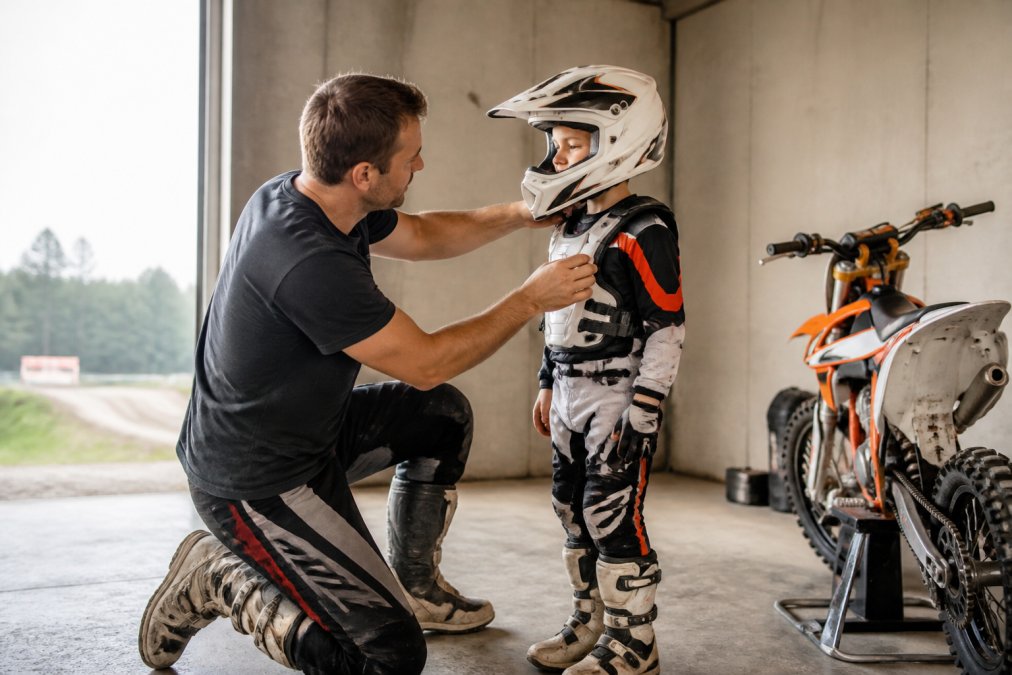
1. Excessive Knee Bend and Restricted Range of Motion
Knee bend is the clearest early signal. If your child's knees stay sharply bent even when standing on the pegs, the bike is now too small for their leg length.
Watch for these clues:
- Knees stay bent past 90 degrees while standing
- They can't fully straighten a leg on the peg
- They complain of knee ache after riding
- They sit down more often than they stand
2. Handlebar Clearance Issues and Difficulty Reaching the Ground
Handlebar clearance problems show up as awkward body positioning. Your child leans too far forward or locks their arms to reach the bars.
Check for these:
- They can't reach the brake lever without stretching
- Throttle control feels jerky because their grip is wrong
- They tip-toe or can't touch the ground at stops
- Their elbows stay locked instead of bent
3. Physical Discomfort, Soreness, and Fatigue After Riding
Fatigue after riding is normal. Soreness from fighting your own gear is not.
Signs to watch:
- They tire out much earlier than usual
- They rub their shoulders or hips after a moto
- They ask to stop early
- They ride stiffer than they used to
Youth Motocross Gear Sizing Guide: How to Measure at Home
Measure at home every few months. Growth spurts don't wait for the start of the season.
Here's what to check:
| Item | What to Measure | Sign It's Too Small |
|---|---|---|
| Helmet | Head circumference above the ears | Lifts when you pull the back up |
| Boots | Toe-to-heel length | Toes touch the front |
| Chest protector | Torso length and shoulder width | Rides up or leaves ribs exposed |
| Jersey and pants | Chest, waist, and inseam | Pulls tight at the shoulders |
| Gloves | Palm width and finger length | Fingers press the tips |
How to Fit a Child's Motocross Helmet (and Know When It's Too Small)
Helmet fit is the single highest-stakes check on this list. A motocross helmet has to stay planted through a face-first case, a bar-to-chest get-off, and the rotational load of a high-side, none of which a loose or undersized shell can manage.
The three-point fit test
Do this with the chin strap buckled, not loose:
- Roll test. Grip the helmet at the sides and roll it forward and back. The skin above the brow should move with the shell. If the helmet slides over the skin, the liner is too loose.
- Lift test. Push up on the back of the shell. The front should press down on the forehead, not lift away. A helmet that peels off the front of the head will do the same thing in a crash.
- Shake test. Have your child shake their head side to side and nod. The helmet should move as one unit with the head, with no lag and no rattle.
What too-small actually looks like
An undersized helmet is not just uncomfortable, it's a pressure-point problem. Watch for:
- Red marks or a headache within 10-15 minutes of wear
- Pressure above the eyebrows or at the temples
- Ears folded or pinched by the cheek pads
- Your child pulling the helmet off the moment they stop riding
What too-loose actually looks like
- The helmet rotates independently of the head when you push the chin bar sideways
- The brow sits high enough that you can see the forehead hairline
- The chin strap can be tightened past the point where the buckle bottoms out
- The helmet shifts when your child looks down at the front fender
A loose helmet is the more dangerous of the two failure modes. On impact, the shell can rotate or slide, which means the energy goes into the skull and neck instead of into the foam. That is the mechanism behind most helmet-related head injuries in youth motocross, and it is why a used helmet that "still looks fine" is not a safe hand-me-down.
Sizing up vs. sizing down
If your child is between two shell sizes, size up only if the smaller size fails the roll or lift test. A helmet that is one size too large cannot be fixed with a thicker liner or a tighter strap, the shell geometry is wrong for the head. If the smaller size passes all three tests with the cheek pads snug, that is the correct helmet, and you replace it when the pads pack out or the head grows past the shell.
Is Youth Motocross Protective Gear Worth the Investment?
Yes, youth motocross protective gear is worth the investment because it's the only thing standing between a growing rider and a hard impact. Kids fall more often than adults, and they heal differently.
What actually matters:
- A certified helmet that fits correctly
- A chest protector that covers the ribs and sternum
- Boots with ankle support
- Knee and elbow guards that stay put
Resale and Hand-Me-Down Gear: Safety Checks Before You Pass It On
Hand-me-downs are how most moto families afford the sport. The problem is that motocross gear fails in ways you cannot see from the outside, and the failure modes are different for every item. Here is what to inspect, item by item, before anything moves down to a younger rider.
Helmets: the one item you should almost never hand down
A helmet is a single-impact device. The expanded polystyrene liner crushes to absorb energy, and it does not recover. That means:
- Any helmet from a crash is done. No exceptions, even if the shell looks perfect.
- Any helmet with an unknown history is done. If you bought it used and don't know whether it hit the ground, treat it as crashed.
- Any helmet past its manufacturer's replacement interval is done. Most brands publish a window, commonly five years from the date of manufacture, because sweat, heat, and UV degrade the foam and adhesives. Find the date sticker inside the shell.
- Any helmet with a cracked shell, compressed liner, or delaminated EPS is done. Squeeze the liner with your thumb; if it feels crunchy or has visible crush marks, retire it.
Boots: check the structure, not the scuffs
Boots take the most abuse and hide the most damage. Inspect:
- Sole separation. Flex the boot hard at the ball of the foot. If the sole lifts from the upper, the boot has lost its structural bond and will peel off in a crash.
- Buckle and strap integrity. Buckles should latch with a firm click and hold under load. Stretched or cracked straps, or buckles that pop open when you pull, mean the boot will not stay on the foot.
- Ankle support. Grab the heel and the toe and twist. The boot should resist. If it folds easily, the ankle protection is gone.
- Stitching at the flex points. Look for pulled or broken stitching at the ankle and toe box, that is where boots fail first.
Chest protectors and body armor
- Straps and buckles. Pull each strap to full tension. If the webbing is frayed or the buckle slips, replace the strap or retire the piece.
- Plastic panels. Flex each panel. Cracks, stress whitening, or delamination mean the panel will shatter instead of deflect.
- Foam padding. Squeeze the padding. If it has gone flat or crumbly, it is no longer absorbing anything.
- Fit on the new rider. A chest protector that fit the older sibling at 8 may sit too high or too low on a smaller torso, leaving the sternum or ribs exposed. Re-check coverage on the actual rider, not the size tag.
Knee and elbow guards, jerseys, and pants
- Knee and elbow guards. Check the hinge or pivot for play, and the shell for cracks. A guard that rotates freely on the joint is no longer protecting it.
- Jerseys and pants. These are the safest hand-me-downs. Check for worn-through knees, blown seams, and stretched waistbands. Fabric failure is a comfort issue, not a safety one, but a waistband that won't stay up will pull the pants down mid-moto.
- Gloves. Check the palm for thinning and the seams for separation. Gloves are cheap enough that worn ones should just be retired.
The 60-second pre-handoff checklist
Before any item moves to a younger rider:
- Confirm the helmet has a known, crash-free history and is inside its replacement window.
- Flex every plastic panel and listen for cracking.
- Pull every strap and buckle to full tension.
- Twist every boot at the ankle and check the sole bond.
- Re-fit the gear on the actual rider and confirm coverage at the ribs, sternum, knees, and elbows.
Moto Dad Racing makes motocross-themed apparel for the whole family, including youth tees like our Eat Sleep Ride youth t-shirt ($19.99), so kids can show their passion off the bike too.

Frequently Asked Questions
What are the safety risks of wearing ill-fitting motocross gear?
Gear that no longer fits leaves gaps where impact protection should sit. A loose chest protector can shift on impact, a helmet that is too big can rotate or come off in a crash, and boots with too much room let the foot slide off the pegs. Restricted knee bend and poor handlebar clearance also reduce control reach, which makes throttle control and brake lever access harder. Any of these raises the chance of a crash or a worse outcome when one happens.
Should I buy motocross gear with room to grow?
No. Buying a size or two up seems practical, but oversized protective equipment moves out of position exactly when it needs to stay put. Helmets, boots, and chest protectors should fit snugly right now, not a season from now. If you want to plan ahead, buy apparel like jerseys and tees slightly loose, and keep protective gear correctly sized. Replace it when your child grows, and pass on the old gear only after a safety check.
How often should you replace a child's motocross helmet?
Replace it whenever it stops fitting snugly, which for growing kids can be every 12 to 18 months during a growth spurt. Also replace any helmet after a hard impact, even if the shell looks fine, because the inner liner can be compressed. Check for a snug fit around the crown and cheeks with no rotation when you push the front of the helmet upward. A used helmet with unknown crash history is not worth the risk.
How do I measure my child for motocross gear?
Use a soft tape measure and take fresh numbers every few months. Measure head circumference just above the eyebrows, chest at the fullest point, waist at the natural line, and foot length heel to toe in centimeters. Check arm and leg length too, since sleeve and pant length affect body positioning on the bike. Write the numbers down with the date, then compare them against each brand's sizing chart before you order, because sizing varies between makers.
Gear that fits is gear that works. If your child is between sizes, growing fast, or riding in gear that's seen better days, it's time to size up. Moto Dad Racing helps families stay comfortable and connected to the sport with motocross-themed apparel for every rider in the house, from youth tees to matching family designs. Get started with Moto Dad Racing and gear up the whole crew for the next race day.