
Durable Motocross Apparel for Active Children: 2026 Guide
Table of Contents
- What Durable Motocross Apparel for Active Children Actually Needs
- Is Youth Motocross Protective Gear Worth the Investment?
- How to Size Kids Dirt Bike Gear the Right Way
- Essential Protective Gear Components for Youth Riders
- Signs of Structural Fatigue in Youth Motocross Apparel
- Maintaining Youth Motocross Apparel Between Race Days
- Motocross Apparel That Brings the Whole Family Together
- Conclusion
Last Updated: August 21, 2026
What Durable Motocross Apparel for Active Children Actually Needs
Finding durable motocross apparel for active children is harder than it looks. Most parents discover this the hard way: a jersey shreds after three rides, a hoodie pills after five washes, and suddenly the gear that seemed like a bargain is already headed for the trash. At Moto Dad Racing, we hear this frustration constantly from parents who want quality that keeps up with kids who ride hard and play harder.
The good news is that knowing what to look for changes everything. Below, we break down exactly what separates gear that lasts from gear that doesn't, how to size it correctly as kids grow, and how to build a smart gear strategy that won't drain your wallet every season.
Material Standards That Hold Up to Real Riding
Youth motocross apparel needs to handle two very different demands simultaneously: it has to absorb impacts and resist abrasion during riding, and it has to survive repeated washing without falling apart. Many parents underestimate that second requirement.
For jerseys and base layers worn during riding, look for reinforced stitching at stress points, particularly the shoulders, elbows, and collar. Stretch panels in the arms and torso allow full range of motion without tearing seams mid-ride. Moisture-wicking fabrics keep younger riders comfortable during longer sessions by pulling sweat away from the skin, which matters more than most gear guides acknowledge. Overheating is a real performance and safety concern for children.
For everyday motocross-themed apparel, fabric weight and construction quality determine how well a piece survives the wash cycle. According to Textile Exchange's fiber performance guidelines, ring-spun cotton produces a softer, more durable yarn than open-end spun alternatives because the fibers are more tightly aligned. This is exactly why the Moto Dad Racing youth tee uses ring-spun cotton as its base construction.
Durable fabrics in the motocross apparel category typically combine cotton for comfort with polyester for shape retention and abrasion resistance. A 50/50 blend handles repeated washing better than 100% cotton alone, which tends to shrink and lose structure over time.
Casual Motocross Apparel vs. Protective Riding Gear: Know the Difference
This distinction matters enormously, and most buying guides blur it completely.
Casual motocross apparel includes tees, hoodies, and lifestyle clothing that celebrates the sport. These are designed for comfort, style, and everyday wear. They are not impact-rated and should not be worn as a substitute for protective gear during actual riding.
Protective riding gear includes helmets, chest protectors, boots, and armored jerseys built to meet safety certification standards for impact absorption and abrasion resistance.
Both categories have a place in a young rider's wardrobe. The mistake is treating them as interchangeable.
Is Youth Motocross Protective Gear Worth the Investment?
Youth motocross protective gear is absolutely worth the investment, and the reasoning is straightforward: children's bodies are more vulnerable to impact injury than adults', and the consequences of inadequate protection are more severe. The question isn't whether to invest in proper gear, but how to do it intelligently given how fast kids grow.
The financial hesitation is understandable. Quality helmets, chest protectors, and boots represent real money, and a child can outgrow a helmet in a single season. But the alternative, underprotecting a young rider to save money, is not a trade-off worth making.
As documented in the American Academy of Pediatrics' guidelines on youth sports safety, properly fitted protective equipment significantly reduces the severity of injuries in youth motorsports. The key phrase is "properly fitted", gear that doesn't fit correctly provides substantially less protection than its rating suggests.
Growth-Cycle Planning: Budgeting as Your Child Grows
The biggest financial mistake parents make is buying gear one piece at a time without a plan. A smarter approach is to think in growth cycles and prioritize accordingly.
Here's a framework that works for most families:
| Gear Category | Replacement Frequency | Priority Level | Notes |
|---|---|---|---|
| Helmet | Every 1-2 years (or after impact) | Critical | Never delay replacement after a crash |
| Chest protector | Every 2-3 years | High | Check for cracked chassis panels |
| Boots | Every 1-2 years | High | Ankle support degrades with wear |
| Goggles | Every 1-2 years | Medium | Lens scratches reduce visibility |
| Jersey/pants | Every season | Medium | Inspect seams and abrasion zones |
| Casual apparel | As needed | Standard | Size up slightly for longer wear |
The practical move: buy protective gear (helmet, chest protector, boots) at the start of the correct size rather than the end of the previous one. Yes, it will be slightly large initially. For casual motocross apparel like tees and hoodies, sizing up one step extends the wear window significantly without affecting safety.
How to Size Kids Dirt Bike Gear the Right Way
Sizing kids' dirt bike gear correctly is the single most common area where parents make expensive mistakes. Gear that's too large doesn't protect properly; gear that's too small restricts movement and gets outgrown immediately.
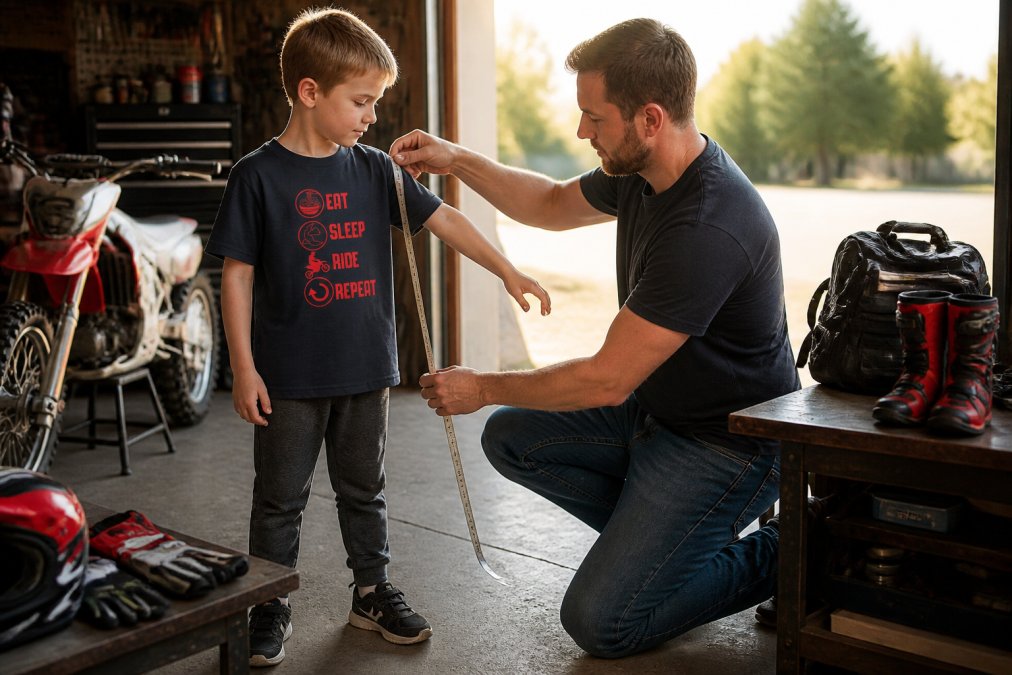
Start with measurements, not age labels. Youth sizing varies significantly across manufacturers, and age-based sizing alone is unreliable. Take these measurements before every purchase:
- Height (top of head to floor, standing straight)
- Chest circumference (fullest part of chest)
- Waist circumference
- Inseam length
- Head circumference (for helmet sizing)
Compare these measurements directly against the specific brand's size chart, not a generic youth sizing guide.
Sizing Toddlers and Young Riders (Ages 3-7)
This age range is where parents get the most confused, and where the stakes are highest because fit affects both safety and comfort.
For riders ages 3 to 7, the ergonomic design of the gear matters as much as the size. Toddler-specific cuts place padding and protection differently than scaled-down adult designs. A chest protector designed for a 3-year-old should have a lower chassis construction profile that doesn't restrict arm movement or chin mobility.
For helmets, the fit check is simple: the helmet should not rock forward, backward, or side to side when the chin strap is fastened. If it moves more than about one centimeter in any direction, it's too large. A helmet that's too large is not safer than no helmet at all in certain impact scenarios.
For casual apparel like tees and hoodies for this age group, parents frequently ask whether toddler sizes are available. Many families with 3- to 5-year-olds find that youth XS sizing fits well, though checking the specific chest and length measurements is always the right move before ordering.
Essential Protective Gear Components for Youth Riders
Off-road safety for young riders depends on a complete protective system, not individual pieces. Each component addresses a different injury risk, and gaps in coverage compound risk rather than simply leaving one area unprotected.
Helmets, Goggles, and Chest Protectors
The helmet is non-negotiable. For youth motocross riders, look for helmets that meet the SNELL Foundation's youth helmet certification standards, which test for impact absorption, penetration resistance, and retention system effectiveness. A helmet that only meets DOT standards is a minimum baseline; SNELL or ECE 22.06 certification indicates a higher level of testing rigor.
Goggle fitment connects directly to helmet choice. The goggle frame needs to seal flush against the helmet's eye port without gaps at the top or sides. Gaps allow roost and debris to enter at speed, which is a significant eye injury risk. Many helmet brands publish compatible goggle lists, and it's worth following those recommendations.
Chest protectors for youth riders should offer full-coverage protection across the sternum, ribs, and shoulder blades. Look for hard-shell panels over a foam impact absorption layer, with articulated fit at the shoulders and waist so the protector moves with the rider rather than shifting on impact.
Integrating Neck Braces with Youth Chest Protectors
This is an area most buying guides skip entirely, and it's a genuine safety gap.
Neck braces work by limiting the range of cervical motion during a crash, reducing the risk of hyperflexion or hyperextension injuries. For youth riders, the integration between the neck brace and the chest protector is critical. A poorly matched combination can actually reduce the effectiveness of both pieces.
The key compatibility check: the neck brace must sit on the chest protector's integrated collar without riding up or creating pressure points on the back of the helmet. Most youth-specific neck braces are designed to work with specific chest protector profiles. Buying these two pieces as a matched system rather than separately is strongly recommended.
Not every youth rider needs a neck brace from day one. Many coaches recommend introducing them when a child begins riding at higher speeds or on more technical terrain. Starting that conversation with a certified youth riding coach is the right approach.
Boots and Ankle Support for Off-Road Safety
Ankle injuries are among the most common in youth motocross, and proper boots are the primary prevention tool. A quality youth motocross boot should provide rigid ankle support without eliminating all flex, because some flex is necessary for controlled riding input.
Look for boots with heat-resistant panels on the inner leg where the exhaust pipe runs closest, reinforced toe boxes, and a sole that grips pegs without catching. The fit should be snug through the ankle and midfoot with a small amount of room at the toe. A boot that's too loose will shift on impact and fail to provide the ankle support it's rated for.
Signs of Structural Fatigue in Youth Motocross Apparel
Most parents replace gear on a calendar schedule and miss the actual warning signs that gear has failed structurally. Calendar schedules are a useful baseline, but physical inspection tells you more.
For protective gear, look for:
- Cracked or delaminating chassis panels on chest protectors, especially around the sternum and shoulder connections
- Compressed foam that no longer springs back after you press it with a finger
- Frayed or stretched retention straps on helmets, which indicate the strap has absorbed impact loads
- Sole separation or cracking on boots, particularly at the toe box and heel
For synthetic fabric riding apparel, signs of structural fatigue are subtler. Abrasion-resistant panels that have thinned to the point of translucency have lost most of their protective value. Reinforced stitching that shows fraying at stress points is a reliable indicator that the garment will fail at those seams under load.
A common mistake is treating visual cleanliness as a proxy for structural integrity. A jersey can look fine and be structurally compromised. The inspection should be tactile, not just visual.
Maintaining Youth Motocross Apparel Between Race Days
Proper maintenance extends the life of motocross apparel significantly, and the rules are straightforward once you know them.
For protective gear: never machine wash helmets, chest protectors, or boots. Wipe down hard surfaces with a damp cloth and mild soap. For helmet liners that are removable, hand wash in cool water and air dry completely before reinserting. Heat from a dryer degrades foam and adhesive bonding inside protective gear.
For fabric riding apparel and casual motocross gear:
- Wash in cold water on a gentle cycle
- Turn jerseys and graphic tees inside out before washing to protect printed designs
- Avoid fabric softeners, which break down moisture-wicking treatments
- Air dry when possible; if machine drying, use low heat only
- Store gear flat or hanging, never compressed in a bag for extended periods
The thing nobody mentions: mud left to dry and cake on synthetic riding fabrics works like sandpaper during the next wash cycle, accelerating fabric wear. Rinse mud off gear before it dries whenever possible.
Motocross Apparel That Brings the Whole Family Together
The best part of motocross culture is that it's genuinely a family sport. Parents ride with their kids, cheer from the sidelines, and build a shared identity around something they all love. The apparel you wear to the track, the pits, and the post-race barbecue is part of that identity.
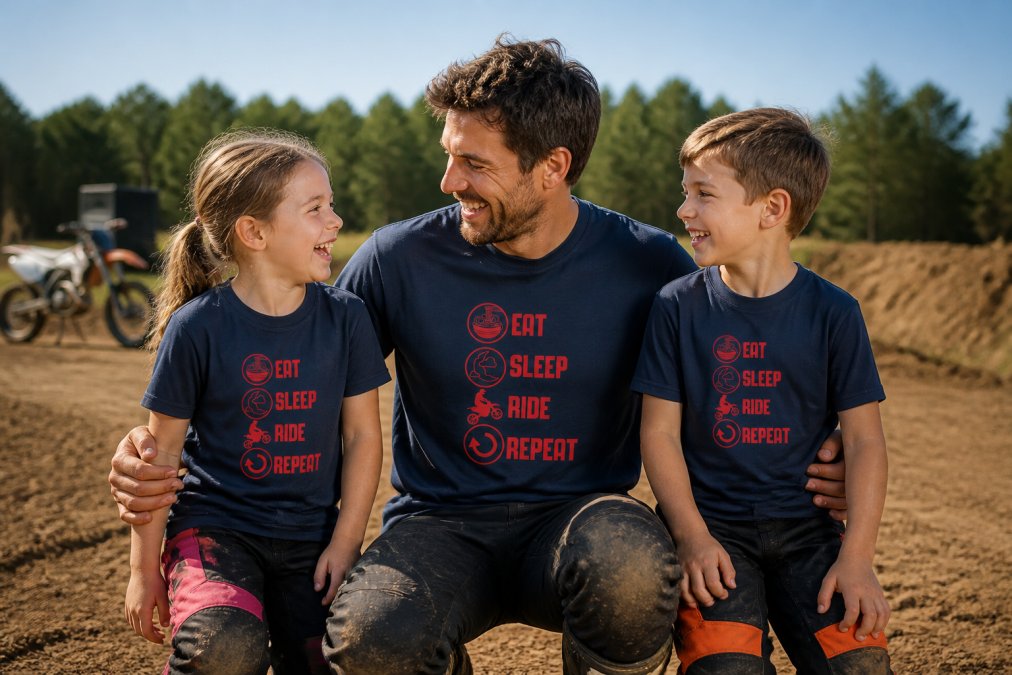
Moto Dad Racing was built specifically for this. The collection covers the whole family, from toddler sizes through adult, with designs that feel cohesive without being over-the-top. The youth tee, like the Eat Sleep Ride youth t-shirt at $19.99, uses ring-spun cotton construction that holds up to the kind of treatment kids put clothes through, and it's sized to actually fit younger riders rather than being a shrunken adult cut.

For fathers who want something that reflects their passion without screaming "matching family outfit," the designs lean into motocross culture rather than novelty. The goal is gear that looks right at the track and feels comfortable everywhere else.
As noted in the Motorcycle Industry Council's participation reports, family participation in off-road riding has grown steadily, with more households treating motocross as a multigenerational activity rather than a solo pursuit. Apparel that reflects that shared identity is part of what makes the culture stick across generations.
Frequently Asked Questions
What is the difference between casual motocross-themed apparel and protective riding gear?
Casual motocross apparel, like graphic tees and hoodies, is designed for comfort, style, and showing off your passion for the sport at events or everyday wear. Protective riding gear, including chest protectors, helmets, and reinforced jerseys, is engineered specifically to absorb impact and resist abrasion during actual riding. Both have a place in a young rider's wardrobe, but they serve completely different purposes. Never substitute a fashion tee for purpose-built protective gear when your child is on the bike.
How do you properly size motocross gear for a child?
Measure your child's height, weight, chest, and waist before buying any youth dirt bike gear. For helmets, measure head circumference just above the eyebrows. Jerseys and pants should allow full range of motion without excess fabric bunching near joints. Boots should fit snugly with one finger of room at the toe. For casual apparel like tees and hoodies, standard youth sizing charts by age and chest measurement work well. Always check the brand's specific size chart, since youth sizing varies between manufacturers.
Is youth motocross protective gear worth the investment?
Yes, especially for children who ride regularly. Youth-specific protective gear is sized and weighted for smaller bodies, which means better fit and more effective impact protection than adult gear scaled down. A properly fitted chest protector, helmet certified to CPSC or ASTM F1952 standards, and ankle-supporting boots reduce injury risk significantly. The upfront cost is real, but gear that fits correctly protects better and often lasts a full riding season. Budget for replacements every one to two years as your child grows.
How often should you replace motocross apparel for growing children?
Protective riding gear should be replaced whenever it no longer fits correctly, typically every one to two seasons for fast-growing kids. Helmets must be replaced after any significant impact, regardless of visible damage. Casual motocross apparel like tees and hoodies can be worn until outgrown or worn out. Check jerseys and pants regularly for signs of structural fatigue: thinning fabric at the knees, fraying seams, or fading reinforced stitching. When protective function is compromised, replace the item rather than repair it.
Keeping young riders properly outfitted as they grow is one of the real ongoing challenges of parenting in the motocross world. Gear needs change fast, budgets are real, and quality matters more than most casual guides acknowledge. Moto Dad Racing makes the everyday side of that equation easier, with family-focused motocross apparel designed to last, fit correctly, and represent what your family is actually about. Browse the collection and find the pieces that fit your crew.
This article was written using GrandRanker