
Comfortable Motocross Gear for Track Days: 2026 Guide
Table of Contents
- Motocross Gear Checklist for Beginners: What You Actually Need
- Choosing Comfortable Motocross Gear for Long Track Days
- Best Moisture-Wicking Base Layers for Dirt Biking
- Jersey and Pant Material: Breathability and Abrasion Resistance
- Ergonomics of Comfort: Reducing Fatigue Over a Full Session
- Casual Motocross Apparel for Trackside Comfort
- Gear Maintenance and Cleaning: Making Your Motocross Gear Last
- Conclusion
Last Updated: August 19, 2026
Picking the wrong gear for a track day costs you lap times and, more importantly, safety. This guide covers comfortable motocross gear for track days, from DOT-certified helmets to moisture-wicking base layers and trackside apparel that keeps the whole family comfortable between motos.
Motocross Gear Checklist for Beginners: What You Actually Need
A complete motocross gear checklist for beginners covers seven core items: helmet, goggles, chest protector, gloves, jersey and pants, boots, and knee braces. Every one has a job to do, and skipping any is a decision you'll feel immediately on the track.
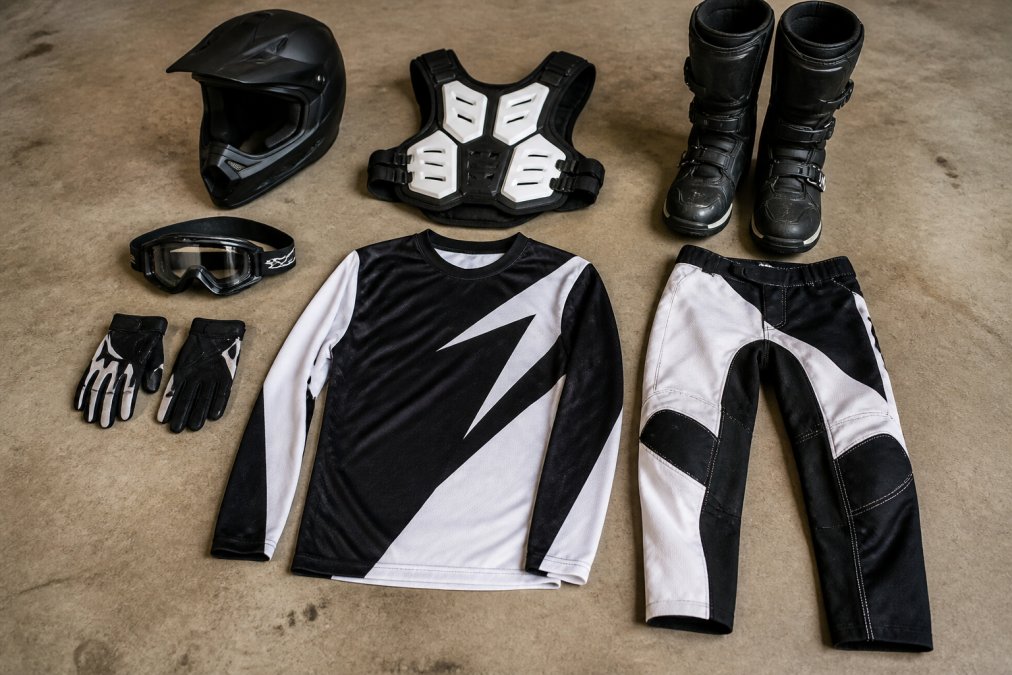
You don't need the most expensive version of each item. You need the right version. Gear that fits properly and meets current safety certifications will always outperform expensive gear that's the wrong size or type for your riding style.
| Gear Item | Primary Function | Key Spec to Check |
|---|---|---|
| Full-face helmet | Head and face impact protection | DOT, SNELL, or ECE certification |
| Goggles | Visibility and eye protection | Anti-fog lens, snug fit to helmet |
| Chest protector | Torso and back impact absorption | CE Level 1 or Level 2 rating |
| Gloves | Grip, feel, and knuckle protection | Articulated armor, breathable palm |
| Jersey and pants | Abrasion resistance, ventilation | Moisture-wicking, reinforced panels |
| Boots | Ankle support and sole grip | Tall shaft, buckle closure |
| Knee braces | Joint protection and lateral stability | Articulated hinge, snug fit |
Helmet Safety Standards and Ratings (DOT, SNELL, ECE)
A full-face helmet is the single most important piece of protective equipment a motocross rider owns. Three certification standards matter: DOT, SNELL, and ECE.
DOT (Department of Transportation) is the federal minimum standard required for street-legal use. According to the DOT Federal Motor Vehicle Safety Standard 218, helmets must meet impact attenuation and penetration resistance requirements.
SNELL certification applies more rigorous multi-impact testing than DOT. The Snell Memorial Foundation helmet safety standards makes SNELL-rated helmets a strong choice for track days where impact speeds are higher.
ECE 22.06 is the European standard, and many helmets sold in the US carry it alongside DOT. It includes rotational impact testing that the older DOT standard doesn't address.
For track days, look for at least DOT certification, and prioritize SNELL or ECE 22.06 if budget allows. A snug fit matters as much as the rating. The helmet should sit level, not rock side to side, and the cheek pads should press firmly without causing pain.
Body Armor, Chest Protectors, and Knee Braces
Standalone chest protectors and knee braces offer better impact protection than integrated options for track days. A chest protector covers the sternum, ribs, and spine with articulated armor panels that flex with your body without restricting riding posture. Look for CE Level 2 impact absorption ratings.
Knee braces provide lateral joint support that guards simply can't match. A common mistake is buying braces that are too loose, they shift during riding and provide almost no protection when it counts. Size them to your leg measurements, not your pants size.
Choosing Comfortable Motocross Gear for Long Track Days
Comfort over a full session is different from comfort for a single moto. Gear that feels fine for 20 minutes can become fatiguing over three or four hours. Riders who struggle most with fatigue are usually wearing gear that restricts natural riding posture or traps heat without adequate ventilation.
Comfortable motocross gear starts with fit. Every item should allow full range of motion without binding at the knees, elbows, or shoulders.
Boots: Ankle Support Without Sacrificing Feel
Good motocross boots have a tall shaft (typically 16-18 inches) for ankle support, multiple buckle closures that can be adjusted independently, and a sole with enough grip for rocky or muddy surfaces. The ankle support comes from the boot's internal frame, not from lacing it so tight you cut off circulation.
Break new boots in before a track day. Riding in stiff, unworn boots for a full session causes blisters and sore ankles.
Gloves: Grip, Feel, and Protection on the Bars
Gauntlet gloves, the long-cuff style that extends past the wrist, offer better protection than short-cuff versions for most track riding. Silicone grip patches reduce the grip force needed to hold the bars, which directly reduces forearm fatigue over a long session. Articulated knuckle armor protects against handlebar impacts without interfering with lever feel.
Sizing is critical. Gloves that are too large bunch at the palm and reduce sensitivity. Too small, and they restrict blood flow, causing hands to go numb.
Goggles: Visibility, Anti-Fog, and Ergonomic Fit
Poor visibility on a track isn't just uncomfortable, it's dangerous. Anti-fog lenses use dual-pane construction that keeps the inner lens surface above the dew point. Single-pane lenses fog the moment you stop moving. For track days where you're frequently stationary in the pits, dual-pane is worth the extra cost.
Goggles should sit flush against the helmet's eye port with no gap at the forehead or chin. A gap lets in roost and dust, ending your visibility within a lap. According to the American Optometric Association's sports eye protection guidelines, impact-rated lenses should meet ANSI Z87.1 standards for high-velocity impact resistance.
Best Moisture-Wicking Base Layers for Dirt Biking
The best moisture-wicking base layers sit directly against your skin and move sweat away from your body before it can cool you down uncomfortably or cause chafing.
Synthetic fabrics, polyester and nylon blends, outperform cotton for base layers in almost every riding condition. Cotton absorbs moisture and holds it against your skin. Synthetic fabrics wick it to the surface where it can evaporate. On a 90°F day, the difference in heat management is noticeable within the first moto.
Look for base layers with flatlock seams, which lie flat against the skin and don't create pressure points under armor.
Layering Systems for Variable Weather Conditions
Track days don't always happen in ideal conditions. A layering system that adapts to variable weather keeps you riding comfortably across the full day.
The three-layer approach works well for motocross:
- Base layer: Moisture-wicking synthetic fabric, compression or relaxed fit, worn directly against skin
- Mid-layer (optional): Lightweight fleece or thermal jersey for cold starts, removed once the track warms up
- Outer layer: Motocross jersey and pants with ventilation panels, worn over armor
The key is keeping the mid-layer thin enough to fit under your chest protector without restricting movement.
Jersey and Pant Material: Breathability and Abrasion Resistance
Jersey and pant material must breathe well enough to manage heat while resisting abrasion in a fall. Modern motocross jerseys use lightweight polyester mesh across the back, shoulders, and underarms for ventilation, while reinforcing high-wear areas like the elbows and forearms with denser weaves. Pants follow the same principle, with mesh inner panels in the thighs and seat for breathability and reinforced outer panels at the knees and hips for protection.
Pre-curved knee construction allows a natural riding posture without the fabric pulling tight across the joint. When sizing, wear your knee braces in place before committing to a size.
Ergonomics of Comfort: Reducing Fatigue Over a Full Session
Rider fatigue on a track day is rarely caused by fitness alone. More often, it comes from gear that forces you into an unnatural riding posture, creates pressure points, or requires constant micro-adjustments.
The most common ergonomic problem is a helmet that's too heavy or sits too far forward. A heavy helmet increases neck fatigue significantly over a full day. Modern helmets have reduced weight through composite shell construction, and the difference between a 3.5-pound helmet and a 2.8-pound helmet is felt clearly by day's end.
Boot fit affects riding posture more than most riders expect. Boots that are too tall relative to the rider's leg length force the knee into a bent position during standing riding, fatiguing the quads. Boots that are too short don't provide enough shin support, causing the rider to grip the bike harder with their legs to compensate.
Glove padding placement matters for long sessions too. Thick padding at the palm base reduces vibration transmitted from the handlebars, which is a primary cause of forearm pump.
Casual Motocross Apparel for Trackside Comfort
Not every moment of a track day involves riding. Riders spend significant time in the pits: watching other motos, working on the bike, eating, and watching their kids ride.
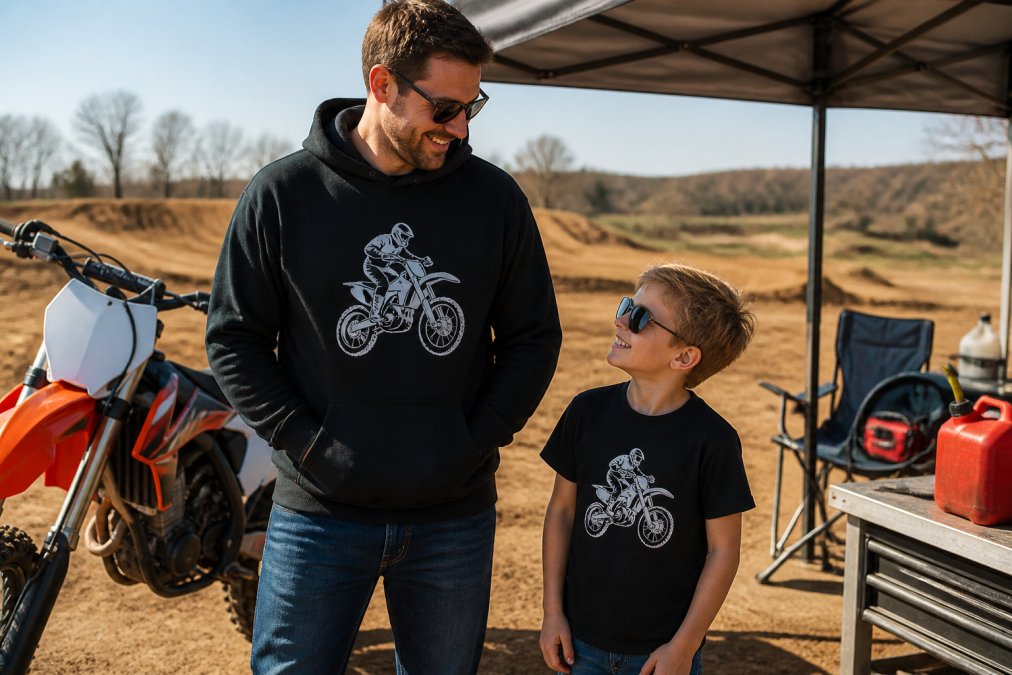
Moto Dad Racing builds casual motocross apparel specifically for this part of the day. The collection covers hoodies and tee shirts designed for the whole family, with motocross-themed graphics that work at the track and away from it. Track days are often a family event, and having matching apparel for the kids makes the experience feel more cohesive. Moto Dad Racing offers sizes that accommodate young children, making it practical to kit out the whole crew in coordinated gear.
Casual trackside apparel should be durable enough to handle a day at the track, contact with bike grease, dust, and pit area chaos. Look for tee shirts and hoodies made from heavier fabric weights that hold their shape after repeated washing.
Gear Maintenance and Cleaning: Making Your Motocross Gear Last
Gear maintenance is where most riders lose money. Motocross gear isn't cheap, and neglecting basic cleaning and storage cuts its lifespan significantly.
Helmet:
- Remove the liner and cheek pads after every session and hand wash in warm water with mild soap
- Wipe the shell with a damp cloth; avoid solvent-based cleaners that degrade the outer coating
- Store in a bag away from direct sunlight, which degrades EPS foam over time
- Replace after any significant impact, even if no damage is visible
Goggles:
- Rinse the frame and strap with clean water after every session
- Replace the lens when scratches affect visibility; most goggles accept replacement lenses
Gloves:
- Hand wash with mild soap and air dry away from direct heat
- Avoid machine washing, which degrades the silicone grip panels and articulated armor stitching
Jersey and pants:
- Machine wash on a gentle cycle with cold water
- Air dry; tumble drying degrades elastic panels and mesh ventilation sections
Boots:
- Remove insoles after every session and air them separately
- Clean mud from buckle mechanisms before it dries and causes the buckles to seize
According to the Consumer Product Safety Commission guidance on protective equipment maintenance, helmets should be replaced every five years regardless of condition, because the EPS foam liner degrades from UV exposure and repeated minor compressions even without a major impact.
Gear that's cleaned and stored properly lasts two to three times longer than gear that's neglected.
| Gear Item | Cleaning Method | Replacement Trigger |
|---|---|---|
| Helmet | Hand wash liner, wipe shell | After impact or every 5 years |
| Goggles | Rinse frame, replace lens when scratched | Lens visibility loss |
| Gloves | Hand wash, air dry | Armor failure or palm wear-through |
| Jersey and pants | Cold machine wash, air dry | Abrasion through reinforced panels |
| Boots | Wipe clean, condition leather | Buckle failure or sole separation |
| Knee braces | Wipe with damp cloth, check hinges | Hinge wear or fit change |
Comfortable motocross gear for track days is a system, not a collection of individual items. Every piece affects how the others perform.
Putting together a complete, comfortable setup takes time and some trial and error, especially for riders new to track days. The gear decisions that matter most are helmet certification, boot fit, and base layer material, get those right and the rest follows. For the time between motos, Moto Dad Racing offers family-focused motocross apparel that keeps everyone comfortable and connected to the sport, from toddler sizes through adult. Browse the collection to find matching hoodies and tee shirts built for the track and beyond.
Frequently Asked Questions
What is the most comfortable motocross gear for long track days?
For long track days, comfort starts with an ergonomic-fit helmet that reduces neck strain, moisture-wicking base layers that manage heat, and articulated armor that allows a full range of motion. Boots with adequate ankle support but a flexible sole help reduce leg fatigue. Lightweight jerseys and pants made from breathable, ventilated materials also make a significant difference when you are riding multiple sessions throughout the day.
Is it better to wear moisture-wicking base layers under motocross gear?
Yes. A moisture-wicking base layer pulls sweat away from your skin and allows it to evaporate through your jersey and armor, which keeps your core temperature lower during hot sessions. Without one, sweat stays against your skin and causes chafing and discomfort over time. For dirt biking, look for base layers made from polyester or nylon blends specifically labeled as moisture-wicking rather than standard cotton undershirts.
What gear do I need for a motorcycle track day?
A standard motocross gear checklist for track days includes a DOT- or SNELL-certified full-face helmet, goggles with anti-fog lenses, a chest protector, jersey and pants with articulated armor, gauntlet gloves, and tall riding boots with ankle support. Knee braces are strongly recommended for anyone riding at speed. Hydration gear like a water pack is also practical for longer events. Check the specific track's requirements before you arrive, as rules vary.
How should motocross gear fit for maximum comfort?
Motocross gear should fit snugly without restricting movement. A helmet should sit level, feel firm around the cheeks and crown, and show no more than two finger-widths of space at the forehead. Jerseys and pants should allow a full range of motion at the shoulders, elbows, hips, and knees. Boots should be secure around the ankle without pinching the calf. Loose gear shifts during a ride and reduces both protection and comfort significantly.
How do I choose comfortable motocross clothing for casual wear at the track?
For casual trackside wear between sessions, prioritize soft, breathable fabrics like cotton-poly blends that handle repeated washing without fading. Hoodies and tee shirts with motocross-themed graphics let you represent your passion without wearing full riding gear in the pits. Look for designs that work for both adults and kids so the whole family can wear matching apparel. Check sizing charts carefully, especially for younger children, to make sure the fit is accurate.
This article was written using GrandRanker