
Best Motocross Apparel for Toddlers: 2026 Parent Guide
Table of Contents
- Why Toddler Motocross Apparel Matters More Than You Think
- Quick Comparison: Top Toddler Motocross Gear Sets
- Is Youth Motocross Protective Gear Worth the Investment?
- Toddler Dirt Bike Safety Gear Checklist
- How to Size Motocross Gear for Toddlers
- Sourcing Sub-4T Sizes and Layering for Weather
- Safety Certification and Used Gear Inspection
- Conclusion
- Frequently Asked Questions
Last Updated: September 14, 2026
Why Toddler Motocross Apparel Matters More Than You Think
The best motocross apparel for toddlers is not miniature adult gear. It is purpose-built protective equipment sized for a 30-pound rider who cannot yet brace for a fall. At Moto Dad Racing, parents fitting their smallest kids for a first ride ask the same question: what actually protects a toddler on a dirt bike?
Toddlers are top-heavy, tip over easily, and cannot absorb impact like an older child. Fitment matters more than brand names: a chest protector that shifts on impact protects nothing, and a helmet that slides forward covers the eyes instead of the skull.
The Consumer Product Safety Commission guidance on helmet safety makes the core point plainly: protective headgear only performs when it fits correctly and carries a recognized safety certification. For a toddler, that margin is even tighter.
Below: the gear checklist, sizing methods, and certification checks that separate real protection from costume gear.
Quick Comparison: Top Toddler Motocross Gear Sets
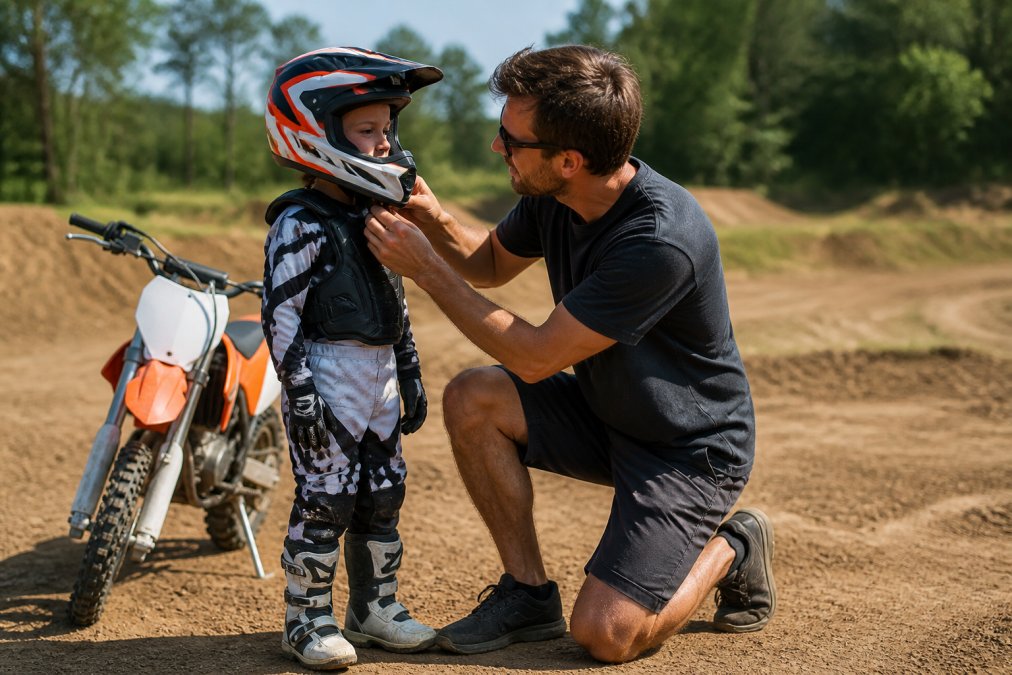
A complete toddler motocross gear set covers six items: helmet, goggles, chest protector, gloves, jersey, and pants or riding boots. Skipping any one leaves a gap a fall will find.
| Gear Item | What It Protects | Fit Priority | Replace When |
|---|---|---|---|
| Full-face helmet | Head, face, jaw | Snug, no rotation | After any impact |
| Goggles | Eyes, from roost and dust | Seals to face | Lens scratches |
| Chest protector | Torso, ribs, spine | Stays put on impact | Cracks in shell |
| Gloves | Hands, grip control | Full finger reach | Seams split |
| Jersey and pants | Skin, abrasion | Allows movement | Fabric thins |
| Riding boots | Ankle, shin, foot | Ankle support locked | Sole wears through |
For families who want the motocross look off the bike too, Moto Dad Racing carries family apparel built for everyday wear, separate from the safety equipment above.
Is Youth Motocross Protective Gear Worth the Investment?
Yes. Toddler bones are still forming, growth plates are open, and a low-speed tip-over on a 50cc bike still produces a real impact. Protective gear is the only variable parents fully control.
Worth it does not mean expensive. The three items that genuinely change outcomes are the helmet, boots, and chest protector; everything else is comfort and abrasion resistance.
A common mistake is buying one size up so the child "grows into it." Loose gear rotates on impact and slides off in a crash. Buy for today's measurements, then re-check fit every few months.
Toddler Dirt Bike Safety Gear Checklist
Run this checklist before every ride, not just the first one.
- Full-face helmet, certified and snug on the crown
- Goggles seated against the face with no gap at the brow
- Chest protector tightened so it cannot rotate
- Gloves with full finger reach to the brake or throttle
- Jersey tucked in, no loose fabric near the chain
- Riding boots with locked-in ankle support
- No drawstrings, scarves, or loose hoods
- Parent within arm's reach at all times
The last item is not gear, but it matters most for a beginner: toddlers do not have the judgment to stop when something feels wrong.
How to Size Motocross Gear for Toddlers
Measure the child, not the age on the tag. Toddler sizing varies wildly between manufacturers.
How to measure a toddler for riding gear:
- Head circumference: wrap a soft tape just above the eyebrows and around the widest point. Match this to the helmet's size chart in centimeters.
- Chest: measure around the fullest part of the chest, under the arms, with the child in a thin shirt.
- Sleeve length: from the base of the neck, over the shoulder, to the wrist bone.
- Inseam: from the crotch seam to the ankle bone.
- Foot length: heel to longest toe, standing, in the socks they will ride in.
Buy to the largest measurement, not the average. A helmet that fits the crown but pinches at the temples comes off mid-ride.
Sourcing Sub-4T Sizes and Layering for Weather
Sub-4T motocross gear is the hardest category to find; most big-box retailers do not stock it. The sizes exist but are scattered across youth-focused lines. Where parents actually find 2T and 3T motocross gear:
- Youth-specific product lines that build down to 2T/3T. Youth-specific product lines often build down to 2T/3T. Availability rotates by season, so check the maker's site directly rather than a marketplace listing.
- Direct-from-maker online stores. Buying straight from the brand's own store is the most reliable way to see the full toddler size run and the current size chart, since third-party sellers often list only the sizes that move fastest.
- Local riding clubs, swap meets, and dealer trade-in racks. Families pass gear down as kids outgrow it, and a dealer that services youth riders often has a used rack. Treat anything secondhand as inspection-only (see the certification section below).
- Specialty youth dealers. A small number of shops focus exclusively on peewee and 50cc-class riders and stock 2T-4T as core inventory rather than a seasonal add-on.
A practical rule: if a listing does not publish a size chart in centimeters for helmets and inches for chest and inseam, assume the fit is a guess.
Layering for Cold and Hot Rides
Layering is where most parents get it backwards. The instinct is a puffy jacket under the chest protector on a cold morning, but a bulky mid-layer pushes the protector out of position, traps sweat, and turns a cold ride into a wet, chilled one once the child stops moving.
The working system: a thin, moisture-wicking base layer against the skin, then the jersey, then the chest protector. Add or remove base-layer weight, not jacket bulk.
- Cold rides (roughly below 50°F): a long-sleeve moisture-wicking base layer (polyester or a poly/spandex blend) under the jersey. Add a wind-resistant shell over the chest protector only if the child is stationary or the wind is biting, never under it.
- Mild rides (roughly 50-75°F): a short-sleeve moisture-wicking base layer or just the jersey. This is the range where cotton becomes a liability, because it holds sweat and cools the child on the descent.
- Hot rides (roughly above 75°F): a breathable, moisture-wicking jersey alone. A cotton tee soaks through and stays wet, which is the opposite of what a toddler needs when they cannot regulate heat well.
Two toddler-specific cautions: they lose heat faster than older kids thanks to a higher surface-area-to-mass ratio, so plan shorter cold-weather sessions; and they overheat faster, so watch for flushed skin and crankiness on hot days and pull them off the bike before it escalates.
Avoid anything loose near the drivetrain: drawstrings, scarves, long hoods, and untucked jersey tails can catch in a chain or sprocket. Tuck the jersey, and skip the neck gaiter unless it is a fitted, breakaway design.
American Academy of Pediatrics guidance on youth sports safety reinforces the same principle for young athletes: equipment should fit the activity and the child, not be adapted from adult gear.
Safety Certification and Used Gear Inspection
Safety certification is the check most parents skip, and it separates a real helmet from a costume. A toy or costume helmet may carry no certification at all; a real one carries a label from a recognized testing body stating what it was tested to withstand.
What the Certification Marks Mean
Three marks show up on youth and toddler helmets sold here, and they are not interchangeable:
- DOT (Department of Transportation, FMVSS 218). The federal minimum for motorcycle helmets sold as motorcycle helmets. It tests impact attenuation, penetration resistance, and retention-system strength (nhtsa.gov). It is the baseline, not the ceiling, it is a self-certification standard, meaning the manufacturer attests to compliance.
- ECE 22.06 (Economic Commission for Europe). A more demanding standard that adds rotational-impact and oblique-impact testing, plus a wider range of impact points on the shell. Many youth off-road helmets now carry ECE 22.06 because it better reflects the angled, low-speed tip-overs toddlers actually experience.
- Snell (M2020D / M2020R). A voluntary, independent standard from the Snell Memorial Foundation. Snell testing is generally considered more rigorous than DOT on impact energy, and the M2020R variant is designed for the rounder headforms common in younger riders.
A helmet can carry more than one mark. What matters: it carries at least one, the label is affixed inside the shell (not a sticker outside), and the size is correct. A certified helmet that is too big protects nothing, because it rotates off the head on impact.
Used Gear Inspection: What You Can Safely Buy Secondhand
Helmets are the one item to buy new, every time. Boots, chest protectors, jerseys, pants, and goggles can be bought used if they pass a structural inspection. Kids outgrow gear in a season, so the secondhand market is deep, but the inspection has to be real, not a glance.
| Item | Inspection Point | Pass | Fail |
|---|---|---|---|
| Helmet | Shell | No cracks, no dents, no deep gouges | Any crack, dent, or gouge that reaches the shell |
| Helmet | Liner | Firm, uniform foam; no soft spots | Compressed, crumbly, or uneven foam |
| Helmet | Straps and buckle | Webbing intact, buckle latches firmly | Frayed webbing, buckle that slips under load |
| Boots | Sole | Fully attached, no separation at the toe or heel | Sole peeling, gaps at the welt |
| Boots | Ankle support | Stiff, resists side-to-side flex | Ankle flexes freely by hand |
| Boots | Buckles | All buckles latch and hold | Missing, bent, or non-latching buckles |
| Chest protector | Shell | Rigid, no cracks | Cracks, spidering, or soft spots |
| Chest protector | Straps | Intact, elastic still returns | Stretched, frayed, or missing straps |
| Jersey and pants | Fabric | Intact at knees, seat, and elbows | Thin, pilled, or torn through |
| Goggles | Lens and foam | Clear lens, foam seals to face | Scratched lens, foam crumbling or detached |
Two mechanisms drive most used-gear failures. Foam liners and padding compress permanently under impact and do not spring back, why a used helmet is never safe and a cracked chest protector is scrap. And boot soles and ankle supports fatigue from flexing, so a boot that looks fine may have lost the rigidity that protects the shin and ankle in a tip-over.
Replace any item that fails a single line. Used gear is worth buying only when it passes every line above, and only where structural failure is visible. For a toddler the margin for error is smaller than for any other rider, so when in doubt buy new for the helmet, boots, and chest protector, the three items that change outcomes in a crash.
Conclusion
Fitting a toddler for motocross gear is a moving target: kids grow, gear wears, and spring sizing is wrong by fall. Families who get it right re-measure every few months and treat the helmet, boots, and chest protector as non-negotiable.
Moto Dad Racing builds motocross-themed apparel for the whole family, with hoodies and tees designed to celebrate the riding lifestyle on and off the track. Our family-focused designs pair with the safety equipment above so the whole crew looks the part. Browse the Moto Dad Racing collection and gear up the entire family for the next race day.
Frequently Asked Questions
What safety gear is essential for toddler motocross riders?
A full-face helmet certified to DOT or Snell standards, goggles, chest protector, gloves, and riding boots with ankle support are essential. For toddlers, ensure the helmet fits snugly and the chest protector covers the torso without restricting movement. Always check that gear meets current safety standards and is designed for off-road use, not just street riding.
How should toddler motocross gear fit?
Gear should fit snugly but allow full range of motion. Helmets must not slide when the child shakes their head. Jerseys and pants should be close-fitting to avoid snagging but not so tight they restrict breathing. Boots should have minimal heel lift. Always measure your toddler's head, chest, waist, and inseam, then consult the manufacturer's sizing chart. Never compromise on helmet fit.
Can a 3-year-old ride a dirt bike?
Yes, with the right equipment and supervision. Many 3-year-olds start on electric mini bikes or 50cc dirt bikes with training wheels. The key is proper safety gear, a controlled environment, and constant adult supervision. Start with low-speed practice on flat ground. Check that the bike's throttle can be limited and that your child can comfortably reach the controls. Always prioritize safety over speed.
What are the best motocross clothing brands for kids?
Several brands offer youth motocross apparel, but focus on gear that meets safety standards and fits properly. Look for jerseys made from moisture-wicking, abrasion-resistant materials and pants with reinforced knees. Moto Dad Racing offers motocross-themed youth t-shirts starting at $19.99, perfect for casual wear or as a base layer. Always prioritize protective gear for riding, and use casual apparel for off-track comfort.